
Online Store Temporarily Closed. Please Contact us at 918-732-7992 for orders. Mvto. Dismiss
The Muscogee (Creek) Nation operates as a proud, self-determined government, grounded in centuries of resilience and visionary leadership. With origins in the southeastern United States and a rich history as one of the Five Civilized Tribes, we are the fourth-largest tribe in the country, serving a vibrant community of over 100,000 citizens from our headquarters in Okmulgee, Oklahoma.
Rooted in our values of Estemet—giving, reciprocity, and civic engagement—we lead with a commitment to cultural preservation, community empowerment, and education. Our governance, structured with an executive branch, legislative body, and tribal court system, enables us to manage diverse initiatives, including cultural tourism, gaming enterprises, and our esteemed higher learning institution. Through innovative programs like our Native Studies Curriculum, we honor our history, promote the Mvskoke language, and inspire the next generation with the enduring spirit of our people.
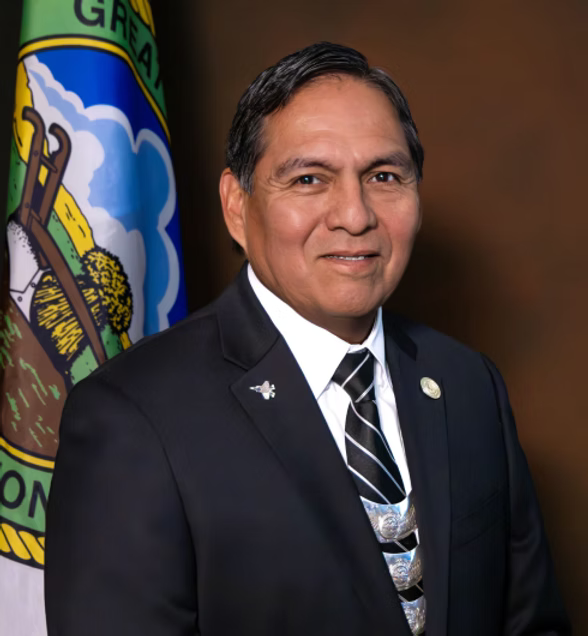
Principal Chief
David W. Hill was elected the seventh Principal Chief in the modern era of Muscogee (Creek) Nation tribal government on December 7, 2019. Prior to being elected Principal Chief, Hill served three consecutive four-year terms as a representative of the tribe’s legislative body, the National Council, after 30 professional years in the aerospace industry. Throughout his first term in office, Chief Hill’s leadership has brought the tribe global recognition for its proactive response to the COVID-19 pandemic and for the Nation’s fierce battle to uphold sovereignty in the wake of the historic Supreme Court decision affirming the Muscogee Reservation. Chief Hill’s leadership was recognized by TIME Magazine, as he was named one of 2020’s 100 Most Influential People.
Second Chief
Del Beaver was elected Second Chief of the Muscogee (Creek) Nation in November 2019 and is a second-generation tribal leader. Beaver is the son of Mariam (Bruner) Beaver and the late R. Perry Beaver, who served as MCN Principal Chief for two terms (1996-2003). He is of the Aktvyahcvlke clan and his tribal town is New Tulsa. After graduation Jenks High School, Beaver received both a Bachelor’s and Master’s Degree from Northeastern State University in Environmental Management and Operations Management respectively. From 2005-2016, he served the Muscogee Nation in the Office of Environmental Services including the last four years as Director. Under his leadership, the OES enjoyed tremendous growth and expansion which included the Nation’s very first Recycling Center and several added resource programs within the department.
In 2016, Beaver began his public service career as he was elected to the National Council representing the Okmulgee District, and held the office until being elected Second Chief.
Away from his executive leadership duties with the Nation, Beaver is also the Associate Pastor at Native Stone Baptist Church in Sapulpa. He and his wife Rhonda (Lowe) reside in Morris and are the proud parents of children Isaiah, Olivia and Adele.

Our mission is to honor the traditions and heritage of the Muscogee (Creek) Nation while fostering a thriving, self-sustained community. We are committed to preserving our culture, promoting education, and ensuring the well-being of our citizens through comprehensive services and initiatives.
The Muscogee (Creek) Nation’s leadership consists of an executive branch, a legislative body, and a tribal court system. Our leaders are dedicated to guiding our nation with integrity, vision, and a commitment to the prosperity of our people. Together, they work to uphold our values, drive economic growth, and preserve our cultural heritage.
Mvskoke People: Older than America
Long before the establishment of the United States, the Mvskoke people thrived as a deeply rooted, sovereign nation with a rich cultural heritage. Their origins trace back to the southeastern United States, where they developed a complex societal structure, complete with clans, governing systems, and enduring traditions. Known for their resilience, adaptability, and reverence for community and the natural world, the Mvskoke people’s history is one of perseverance and ingenuity. Their story exemplifies the spirit of a people “older than America,” whose culture and values continue to shape their identity today.
Conflict and Removal
The 19th century brought profound challenges for the Mvskoke people as they faced increasing pressure from U.S. expansionist policies. In 1830, the Indian Removal Act set in motion a devastating chapter of forced relocation known as the Trail of Tears. Thousands of Mvskoke citizens were uprooted from their ancestral homelands and marched to Indian Territory, present-day Oklahoma, enduring immense suffering and loss. Despite these hardships, the Mvskoke people maintained their sovereignty and cultural identity, rebuilding their communities and institutions in new lands.
Oklahoma Statehood
The transition to statehood in 1907 marked another pivotal era for the Mvskoke Nation. The formation of Oklahoma involved the merging of Indian and Oklahoma Territories, significantly altering the political and cultural landscape for Native Nations. Tribal sovereignty was often undermined during this time, as land allotment policies and federal oversight sought to assimilate Native populations into mainstream society. Yet, the Mvskoke people remained steadfast, advocating for their rights and preserving their governance, culture, and traditions amid these sweeping changes.